



Choosing a sleeping bag is a very important element, even essential, if you want to enjoy a good night’s sleep, whether in a shelter, bivouacking, under the stars, in a cave, or elsewhere. If you have a bad night, I can guarantee you that the next day might not be very fun.
While writing this, a few bad nights come to mind. Either because of my laziness: “Don’t bother, the tent is fine, we won’t feel the stones” – in fact, yes, we did. Either because of my stupidity: “Don’t worry, my protective cover protects well from the rain” – that’s true, if we don’t take into account the dripping water that soaked my sleeping bag. And sometimes because of a bad choice: “The little duvet will be perfect” – yes, perfect for being really cold…
We’ll deal with laziness and stupidity another day and will first tackle the choice of sleeping bag. This choice depends on several criteria – one of the most important is the type of filling (material inside the sleeping bag), which can be down or synthetic fibers.
To better understand what follows, we must think of the functioning of filling as similar to double glazing. In double glazing, it’s not the glass that insulates; it’s mainly the air trapped between the two panes. In the case of a sleeping bag, it’s not so much the filling that insulates but rather the air trapped in the filling. The more air trapped in the filling, the “warmer” the sleeping bag will be—it’s said to insulate. A sleeping bag doesn’t produce heat, but it retains your body’s warmth by insulating it from the outside.
To help you choose between down and synthetic fibers, you need to understand their characteristics, as well as their advantages and disadvantages.
Down – Characteristics of Down
Down is primarily used for its ability to trap a large volume of air in a small amount of material. All down is different, and the main characteristics influencing the quality of down fillings are discussed below:
- Down Type:Down can come from geese or ducks. It should be noted that the quality of goose down is higher than that of duck down.
- Filling Quality: A filling is not composed entirely of down. In fact, for the filling to be homogeneous, it always contains a small percentage of feathers. This is represented by a down/feather ratio (90/10 means, for example, 90% down and 10% feathers). The higher the down percentage, the better the quality of the filling.
- Fill Power:The fill power of down or Fill Power (FP) corresponds to the volume occupied by one ounce of down. It is measured in cuin (cubic inches). Currently, down has a fill power ranging from 550 to 900 cuin. The higher this number, the better the down quality – because the better its lightness, compressibility (volume-to-weight ratio), and loft. For a given weight of down, the higher its fill power, the better its insulation.
Pros and Cons of Down Filling
Pros |
Cons |
| · Excellent insulation-to-weight ratio (“warmth-to-weight”). · Good compressibility (good volume-to-weight ratio). · Good durability (long lifespan). · Breathable. · Recovers its loft when dry. · Comfortable to sleep on. | · Absorbs moisture. · Does not insulate well when wet. · High price. · Difficult and long drying time. · May cause allergies in some people. · If the sleeping bag becomes punctured or torn, the down may leak out. · Difficult to maintain. |
Synthetic Fibers – Characteristics of Synthetic Fibers
The undeniable advantage of synthetic fibers over down is that they provide good thermal insulation even when wet. This is why they are used in sleeping bags.
There are a multitude of different trademarks and designs, the best known being Primaloft, Polarguard, and Thermolite. Among all the synthetic fibers on the market, there are two main types: those that mimic the structure of down (Primaloft, etc.) and others (Polarguard, Thermolite, etc.).
- Primaloft: has a synthetic structure that imitates natural down. Its fill and compressibility properties are similar to those of down, but it tends to lose its fill more quickly over time.
- Polarguard: It is made of a single synthetic fiber wound around itself. This forms a kind of wadding that is quite strong and rigid, but not very compressible.
- Thermolite: It is made of hollow fibers that provide a good insulation-to-weight ratio. However, this ratio is lower than most downs.
Advantages and Disadvantages of Synthetic Fiber Filling
Advantages |
Disadvantages |
| · Good resistance to moisture from both inside and outside (perspiration, rain, etc.). · Insulates well, even when damp or wet. · Inexpensive because it’s easy to produce industrially. · Quick drying. · Easy to wash. · Easy care. |
· Poor insulation-to-weight ratio. · Poor compressibility (poor volume-to-weight ratio). · Average durability. · Loss of loft with use. |
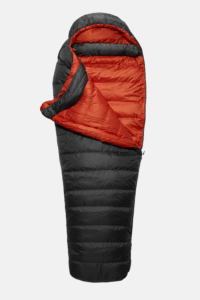
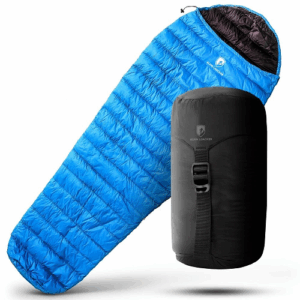
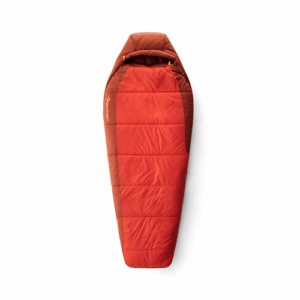
A choice that depends on your practice
Ultimately, there is no clear winner between down and synthetic fibers – each filling has its advantages and disadvantages. It’s up to you to find the winner based on the conditions and how you hike. Here are some points to help you choose based on your priorities:
- Humid environment: If you’re bivouacking in a very humid place, choose a synthetic sleeping bag. This can be the case for nights under the stars, under a tarp (a shelter made of a tarp), in the snow, etc. Sometimes, condensation in a tent is enough to wet a sleeping bag. To overcome this problem, you can use, for example, waterproof sleeping bags or sleeping bags with waterproof-breathable membranes. Furthermore, some down fillings are treated to provide moderate moisture resistance, and some sleeping bags have a waterproof outer fabric.
- Lightness: If lightness and compressibility are your primary criteria, choose down. For example, keeping weight to a minimum is essential for a good time on treks or long hikes. A synthetic sleeping bag can provide the same insulation as a down sleeping bag but with a greater weight and volume.
- Price: If price is your main selection criterion, opt for synthetic. This may be the case if you plan to use it occasionally, for example, to sleep in huts and on short hikes. But also consider that investing in a down filling may be the most economical solution because down has a longer lifespan.
- Allergies: If you have allergies, it’s not easy because it seems to depend on you as well as the type of down, treatment, critters living in it, etc. It’s best to test on a case-by-case basis. But if you want to be sure to avoid allergies, choose synthetic.
- Care: If you’re a washing freak or you’re going on a long trip – and you need to wash your sleeping bag regularly – I recommend synthetic, which is much easier to care for and dries faster.
- Comfort: Finally, if comfort inside the sleeping bag is the most important element for you, down should satisfy you because, well more pleasant than synthetic.
Once you’ve determined whether you need a down or synthetic sleeping bag, there are still a few important criteria to carefully consider before making a purchase. Stick around; one of these days I might share more about how to choose the right sleeping bag.
🌍 TerraZen Market: Your partner for peaceful nights
At TerraZen Market, we offer a selection of eco-designed sleeping bags, suitable for all your adventures. Whether you prefer the comfort of down or the practicality of synthetic, you’ll find the model that matches your needs and values.
Choosing the right sleeping bag is essential to ensuring comfortable nights during your outdoor adventures. Choosing between down and synthetic fiber filling depends on several factors, including climate conditions, weight, budget, and personal preference. Here’s a detailed comparison to help you make the best choice.
🏕️ Down vs. Synthetic: The Match
🪶 Down Sleeping Bag
Pros:
- Excellent thermal insulation: Down offers a superior warmth-to-weight ratio, ideal for cold and dry conditions.
- Lightweight and compressible: Easy to carry, it takes up little space in your backpack.
- Durability: With proper care, a down bag can last for decades.
Disadvantages:
- Sensitivity to moisture: Loses its insulating properties when wet and dries slowly. GR-GO+1Lyophilise+1
- Delicate maintenance: Requires special cleaning care.
- High cost: Generally more expensive than synthetic models. Lyophilise+4GR-GO+4Altituderando+4
🧵 Synthetic fiber sleeping bag
Advantages:
- Moisture resistance: Retains its insulating properties even when wet, making it ideal for humid environments. GR-GO
- Easy Care: Machine washable and dries quickly.
- Affordable Price: Less expensive than down bags.Glisshop
Disadvantages:
- Weight and Bulk: Heavier and bulkier than down for equivalent insulation.
- Less Durability: Tends to lose its loft over time.
🎯 How to choose?
- Humid climate: Opt for a synthetic sleeping bag to avoid the discomfort of humidity.Obelink+14Lyophilise+14Urbania+14
- Low weight: Down is preferable for treks where every gram counts.
- Limted budget: Synthetic sleeping bags offer good value for money.
- Allergies: Synthetic fibers are hypoallergenic, unlike down, which can cause reactions in some people.
- Care instructions: If you plan to Wash your bag frequently; synthetic is more suitable.
🌍 TerraZen Market: Your partner for peaceful nights
At TerraZen Market, we offer a selection of eco-designed sleeping bags, suitable for all your adventures. Whether you prefer the comfort of down or the practicality of synthetic, you’ll find the model that matches your needs and values.
👉 Discover our collection of sleeping bags


